"Manufacturing technologies evolve at a breakneck pace. We went from paper blueprints and manual handles to complex multi-axis CNC machines and automated workflows. But on the shop floor, one rule remains absolutely unbreakable: The mathematical formulas under the iron never change."
Where It All Started
The foundations of Mr. Machinist were poured back in the late 1980s. It originally started as a small, personal right-triangle trigonometry program that I custom-programmed in the BASIC language. Sitting inside a machine shop facing complex setups, I needed a fast way to drop coordinates without spending hours scratching away on index pads or hunting down mathematical charts.
As the code expanded, I realized every machinist on the floor was battling the exact same setups. I completely rewrote and ported the math algorithms over into Pascal, engineering a fully independent software package built strictly for the DOS environment—years before modern windows-based graphical operating systems even arrived in manufacturing facilities.
The Days of BBS and Shareware
Long before modern web browsers, app stores, or high-speed fiber internet existed, independent programmers distributed software through local phone lines using **BBS (Bulletin Board Systems)**.
Mr. Machinist was released as a "Shareware" application. Back then, shareware meant we trusted the craftsmanship of the community: you could download, copy, and try the full program on your shop floor for free. If it solved your coordinates, saved you from scraping expensive stock, and earned its keep on your machine, you mailed in a registration fee to unlock support updates.
And they registered by the hundreds. Mr. Machinist quickly became a benchmark utility. It wasn't just manual operators or mom-and-pop job shops utilizing the math loops; major defense subcontractors, elite aerospace manufacturing plants, and even a high-security nuclear facility deployed Mr. Machinist to double-check blueprint tolerances.
The Jump to Early Windows
When personal computers shifted out of text-based command prompts, I ported the engine a third time, transforming it into a graphical desktop software tool tailored natively for **Windows version 3**.
Eventually, the program grew massively. Between managing complex updates on desktop operating systems, working a demanding schedule on the manufacturing floor, and prioritizing raising a family, I had to freeze development on the original system. Mr. Machinist went on a long hiatus, resting soundly as a proven piece of American manufacturing history.
Back for the Modern Floor
Decades later, the app is officially back. While computers migrated from bulky desktop towers straight into our front pockets, the geometry behind true position deviation, speeds and feeds parameters, and sine plate spacing didn't budge a single thousandth of an inch.
The new Mr. Machinist mobile application features the exact same rugged, uncompromised mathematical reliability that major aerospace companies relied on back in the DOS era, now supercharged with live visual vector graphics, automated PDF inspections, and quoting tools built natively for your smartphone.
A Walk Down Memory Lane
Take a look at how the software appeared on shop monitors over 30 years ago:
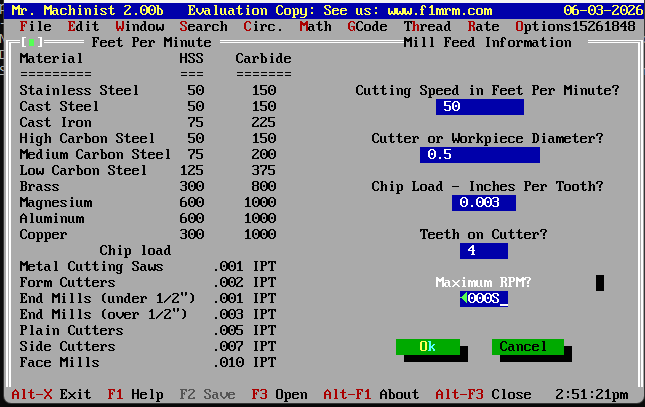
1. DOS Mill Feed & Speed Optimizer (circa 1992)
The original Pascal-engineered DOS loop converting HSS and Carbide surface footage limits directly into spindle RPM and table feed guidelines.
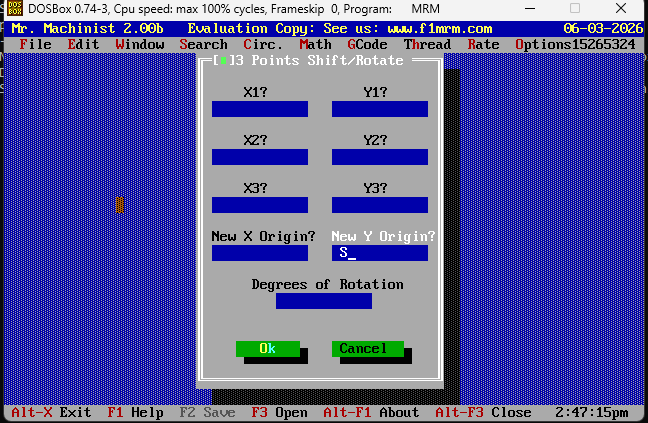
2. DOS 3 Points Circle Shift & Rotate
Advanced coordinate transformation modeling written before modern CAD/CAM layouts were widely available on the production floor.
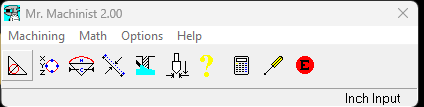
3. The Early Windows Main Menu Toolbar
The step up to graphical operating systems, mapping trigonometry, bolt circles, and tool path tangencies to independent software shortcut buttons.